
Continuous Improvement Is Not Optional: Tools and Methodologies to Boost Performance and Deliver Tangible Results
Continuous Improvement Is Not Optional: Tools and Methodologies to Boost Performance and Deliver Tangible Results
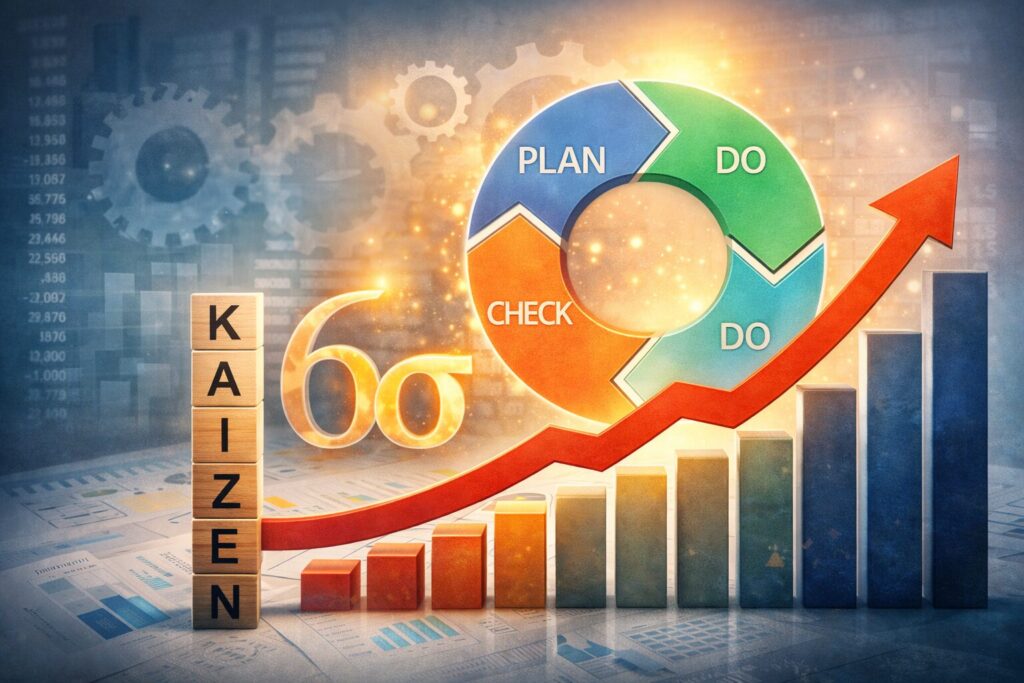
Continuous improvement is not a passing managerial slogan; it is a vital mechanism that ensures organizations can compete and survive in a volatile environment. It combines strategic thinking with systematic toolkits such as Kaizen, Six Sigma, and Lean, turning data into decisions and opportunities into measurable results. And by adopting global frameworks like EFQM and ISO 9001, continuous improvement becomes part of the institutional DNA that preserves quality, raises efficiency, and strengthens organizational sustainability over the long term.
Continuous improvement requires a clear vision, measurable objectives, mechanisms to assess progress, and the ability to adjust course based on derived data. It also necessitates building a strong organizational culture that encourages learning, enables employees to contribute effectively, and promotes transparency and accountability.
Why Has Continuous Improvement Become a Top Necessity?
The need for continuous improvement stems from several key factors shaping today’s business environment:
Rising competitiveness and evolving customer expectations
In today’s world, where consumers are more aware and better informed, delivering merely good products or services is no longer enough. Customers constantly seek the best, and their expectations for quality, efficiency, and personalization are rising. This places immense pressure on companies to continuously enhance their offerings to retain loyalty and attract new customers. Organizations that fail to meet or surpass these expectations quickly find themselves losing market share to more agile and innovative competitors.
Accelerating technological change
The digital revolution and continuous technological advances are changing the rules in every industry. The emergence of technologies such as Artificial Intelligence, Big Data, and automation enables companies to achieve unprecedented levels of efficiency and innovation. However, these developments require organizations to adapt quickly, adopt new tools, and re-engineer processes to keep pace. Continuous improvement provides the framework that allows organizations to integrate and leverage these technologies effectively.
Reducing waste and increasing efficiency
Waste (Muda) in all its forms time, resources, or effort is a major challenge that hinders performance. Continuous improvement, particularly through methodologies like Lean (Lean Thinking/Lean Operations), focuses on identifying and eliminating non-value-adding activities. By reducing waste, organizations can significantly improve operational efficiency, resulting in cost savings and higher profitability. This process affects not only the financial side but also streamlines workflow and reduces operational strain.
Continuous Improvement Tools & Methodologies: A Comprehensive Guide
To achieve continuous improvement, organizations rely on a variety of tools and methodologies, in addition to global frameworks such as EFQM and ISO 9001, which provide clear standards for quality assurance and organizational excellence. These offer structured approaches to identify problems, analyze them, develop solutions, and monitor results. The right choice depends on the nature of the problem, organization size, and defined objectives.
Kaizen: A philosophy of change for the better
“Kaizen” is a Japanese word meaning “change for the better” or “continuous improvement.” This philosophy focuses on small, incremental, and ongoing improvements across all aspects of operations, engaging everyone from senior leadership to front-line teams. The idea is that small, repeated changes create a large cumulative impact over time. Kaizen nurtures a culture of learning, experimentation, and collaborative problem-solving, strengthening ownership and accountability among employees.
Core Kaizen principles:
- Process-oriented thinking: Focus on how processes flow rather than just outcomes.
- Eliminate waste: Identify and remove non-value-adding activities (Muda).
- Total participation: Engage all employees in improvement efforts.
- Problem-solving: Use structured methods to identify root causes and develop solutions.
- Continuous learning: Treat every improvement as an opportunity to learn and develop.
PDCA (Plan-Do-Check-Act): The improvement wheel
Also known as the Deming Cycle, PDCA is a four-stage framework for continuous improvement. It is used to implement changes in a structured way, evaluate effectiveness, and institutionalize lessons learned.
PDCA stages:
- Plan: Identify the problem or improvement opportunity, set objectives, and define the actions needed to achieve them.
- Do: Implement changes on a small or pilot scale to collect data and observe initial results.
- Check: Analyze results and measure them against set objectives. Evaluate effectiveness and determine whether the change delivered the intended impact.
- Act: Based on findings, take the necessary actions. If successful, standardize and roll out; if not, adjust the plan and start a new PDCA cycle.
Six Sigma: Reducing defects and variation
Six Sigma is a data-driven methodology focused on minimizing defects and process variation to the lowest possible level, targeting exceptional quality. It is especially useful in complex operations where precision is critical. Six Sigma typically leverages two primary models:
DMAIC (for improving existing processes):
- Define: Clarify the problem, project objectives, and target customers and their expectations.
- Measure: Gather data on current performance to establish a baseline.
- Analyze: Analyze data to identify root causes of problems and defects.
- Improve: Develop and implement solutions to enhance the process.
- Control: Put mechanisms in place to sustain improvements and prevent regression.
DMADV (for designing new products/processes):
- Define: Set design objectives aligned with customer requirements and business strategy.
- Measure: Identify Critical-to-Quality (CTQs) needs and the capabilities required to meet them.
- Analyze: Evaluate design options and select the best fit for CTQs.
- Design: Develop the detailed design, including prototypes and implementation plans.
- Verify: Test the design to ensure it meets customer requirements and defined objectives.
Lean (Lean Manufacturing/Lean Management): Eliminating waste
Lean focuses on maximizing customer value by eliminating all forms of waste (Muda) in processes. The goal is smooth flow, lower costs, and higher efficiency.
Core Lean principles:
- Define value: Determine what customers perceive as value.
- Value Stream Mapping (VSM): Visualize all steps required to deliver a product/service and identify waste.
- Create continuous flow: Ensure products and information move smoothly without stops or delays.
- Pull system: Produce only in response to actual customer demand rather than forecasts.
- Pursue perfection: Continuously strive to improve and remove additional waste.
Total Quality Management (TQM)
TQM is a comprehensive management approach that engages everyone in the organization to improve quality continually for long-term customer satisfaction. It emphasizes collaboration, data-driven decision-making, and ongoing improvement of processes, products, and services.
Putting Continuous Improvement into Practice
Turning continuous improvement from a concept into measurable results requires a holistic approach building a supportive culture, applying systematic tools, and linking efforts to strategic objectives.
Build a culture of continuous improvement
Continuous improvement is not just a series of projects; it is a mindset and way of working that becomes an inseparable part of the organization’s culture. This requires:
- Leadership commitment: Senior management must visibly commit to continuous improvement and role-model change.
- Employee engagement: Front-line employees are closest to daily operations and best placed to spot issues and propose solutions. Motivate, train, and empower them to participate effectively.
- Transparency and communication: Maintain open communication about improvement goals, progress, and challenges. Transparency builds trust and ownership.
- Learning from mistakes: Treat errors as learning opportunities, not failures.
Ongoing measurement and performance evaluation
You can’t improve what you don’t measure. Organizations should define clear, measurable KPIs to track improvement progress, such as:
- Product/service quality (e.g., defect rate, customer satisfaction).
- Process efficiency (e.g., cycle time, cost to produce/serve).
- Productivity (e.g., output per employee).
- Employee satisfaction and engagement.
- Financial outcomes (e.g., revenue, profit margin).
Review these indicators regularly, use data to pinpoint improvement areas, and make informed decisions. Gap Analysis and Root Cause Analysis are particularly useful here.
Link improvement to strategic objectives
For continuous improvement to be effective, it must connect directly to the organization’s overarching strategy and be governed within an integrated Quality Governance framework that ensures alignment with vision and strategy. This guarantees improvement initiatives contribute to the mission and channel resources to top priorities. Improvement initiatives should be selected based on enterprise objectives, and their outcomes measured by contribution to those objectives.
Tangible Outcomes of Continuous Improvement
Effective application of continuous improvement methodologies yields broad, concrete benefits that strengthen performance across all levels:
- Higher operational efficiency & cost reduction:
By eliminating waste, streamlining processes, and improving flow, organizations achieve higher efficiency, directly translating into lower costs in production, services, and even administrative work. - Improved product and service quality:
Focusing on reducing defects and variation produces higher-quality outputs—lower rework/repair costs, stronger reputation, and greater customer loyalty. - Enhanced customer satisfaction and loyalty:
High-quality outputs coupled with fast, efficient processes elevate the customer experience. Satisfied customers return and recommend, fueling sustainable growth. - Increased productivity and innovation:
A continuous improvement environment frees employees to focus on value-adding activities, unlocking time and resources for innovation, experimentation, and performance gains. - Developed capabilities and higher engagement:
Involving employees in improvement sharpens their problem-solving, analysis, and collaboration skills—benefitting the organization while boosting satisfaction, engagement, and belonging.
Conclusion
Continuous improvement is not a temporary journey; it is a long-term path that demands clarity of vision, disciplined execution, and commitment to a supporting organizational culture. When managed within an integrated Quality Governance framework and powered by tools like Kaizen, Six Sigma, and Lean, improvement efforts turn into tangible outcomes that elevate efficiency, innovation, and customer satisfaction. This is where Empower plays a pivotal role helping organizations adopt global frameworks such as EFQM and ISO 9001, and designing integrated improvement programs directly linked to strategic objectives. We enable true institutional sustainability and a durable competitive edge in a rapidly changing market.